One year
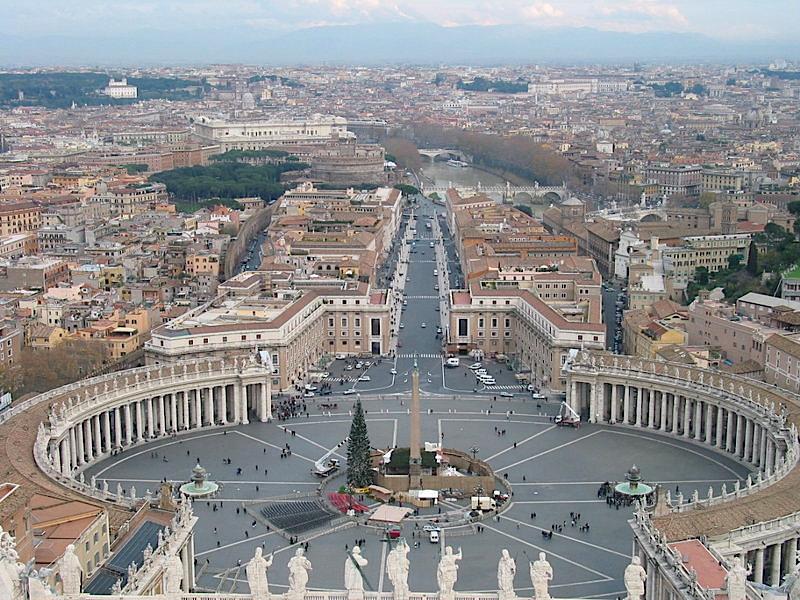
ago, I reported that many Protestants are ready to “cross the Tiber” into Roman
Catholicism. The expression “crossing the Tiber” refers to fording the river
that runs alongside Rome, symbolic of the barrier between Rome and Protestants.
With grief, I had to report that even leaders in our mother church are talking
about making the crossing.1 Some church leaders are sending not-so-subtle
messages to members: It is permissible, and probably time, to unite with the
Catholic Church. One Calvin Seminary faculty member wrote that Protestants
and Catholics are “pilgrims on the same journey, serving one Lord with one
faith” who “will come nearer to their goal if they walk together than if they
walk separately.” If I had not read his words with my own eyes, I would have
been disbelieving of such a report.
The
campaign to bring Protestants (‘Evangelicals’) into Rome gained momentum from a
1995 project called ECT—Evangelicals and Catholics Together. ECT is an ad hoc
committee that in 1995 published a major document, signed by influential Roman
Catholic and Protestant leaders, expressing agreement in fundamental
areas of doctrine and voicing commitment not to proselytize one another’s
members. Since 1995, ECT has published at least nine more statements of unity
in faith. Protestantism’s friendliness with Rome, however, has far deeper roots
(down to the early 1900s) and a much wider reach than ECT (extending broadly
into Protestantism).
In the
year since I wrote that editorial, no other alarms have been raised about this
movement. The silence in church magazines of conservative Protestantism is
grievous. The original pushback in a few good books has seemed to end. A
smattering of Internet articles speak out against it, but even these are not
from the sources we would hope—Reformed and Presbyterian churches.2
Members
of denominations whose leaders support this move to Rome ought to be up
in arms. In churches that are silent, Christians ought to ask their
leaders why no warnings are issued. Readers who have relatives and friends in
denominations that lean toward Rome should equip them with good information, so
they can take the action God requires of them: protest the leanings or leave
those churches, for the salvation of their generations. Those inclined to join
such a denomination where the children are not inoculated against false
doctrine may be warned.
This is
their warning, given in love for their souls: To go to Rome is to lose the
gospel. There is no good news in Rome. In order to join Rome, those churches
that call themselves Protestant must abandon the truth for which our fathers
died and on account of which they left Rome. By definition, Protestants protest.
Their protest was against Rome. By courting Rome, these Protestants
abandon Protestantism.
How could
it happen that churches so radically different historically could consider each
other of the same faith and on the same journey?
Evangelicals
(Protestants) and Catholics are coming together
Definition
of a few terms is in order.
Catholics: A reference to Roman Catholicism,
the world-wide religion based in Rome under the pope. To refer to followers of
the pope merely as Catholics is mistaken since the real catholic,
that is, universal church is the true church of Christ, not Rome.
Followers of the pope are Roman Catholics.
Evangelicals: A term harder to define, but
generally considered to be conservative Protestants. Protestants are
non-Roman Catholic Christians, but these are conservative Protestants.
They have not gone liberal in rejecting the authority of Scripture, the
necessity of regeneration for salvation, miracles, the Virgin Birth, etc. Their
claim to retain the gospel explains the label evangelical. So,
Evangelicals have been the branch of Protestantism that seeks to maintain
Reformation orthodoxy. They are found in most branches of Protestantism, from
Lutherans to Baptists, Presbyterians to Pentecostals to Methodists.3
Together: A reference to reconciliation.
Some Evangelicals and Roman Catholics desire to break down what walls still
separate them. They meet unofficially to discuss common beliefs and assure one
another that what differences exist between them fall into three categories: a
great deal is simple misunderstanding or misrepresentation; much is explained
by historical circumstances no longer applicable; discussing the rest will
cultivate deeper mutual appreciation.
Ecumenical:
Relating
to a movement that aims at world-wide union of all Christian churches. The word
comes from the Greek for “the inhabited world.” The “togetherness” that
Protestants and Roman Catholics seek is nothing less than the complete unity of
all Christian denominations, world-wide.
Roman
Catholics and Evangelicals are reconciling. Evangelicals are ecstatic
about the project. Roman Catholicism is on board, even though initially, in the
early 1900s, it was cold toward any ecumenical efforts because of fear it would
“lose its distinctive Catholic dimensions.” That changed in 1962 when the pope
convened a major council (Vatican II) that brought the Roman Catholic Church
into the ecumenical movement. Vatican II declared unity with their “separated
brethren” one of the “principle and essential goals of the RCC.”4
How can
this be?
How can
it be that Evangelicals, most of whom formerly said “Catholics are not
Christians,” are now able to see unity as possible, desirable, even necessary?
And why is Roman Catholicism no longer fearful of losing its distinctives?
The
answer has two parts: Evangelicals are no longer evangelical. And Roman
Catholics are not changing but engaging in creative shapeshifting. Evangelicals
are guilty of massive compromise of Reformation faith. Roman Catholics are back
to their old tricks, guilty of subterfuge.
From the
side of Evangelicals, consider three major factors that contribute to their
ability to consider Rome their home. At the same time, ask whether your own
church or family may be guilty of these weaknesses, and thus in your
generations may be vulnerable to Rome, where there is no gospel.
- Ignorance of Scripture
Evangelicals
can consider Rome as home because they are ignorant of the doctrines that stood
at the heart of the Reformation. Rome has always depended on their
sheep’s ignorance, but now Evangelicalism is destroyed for lack of knowledge.
While some Evangelical leaders are educated, most of the common members are
woefully ignorant. Public education (not Christian schools) is the norm and
good catechetical instruction in Scripture and creeds is rare. This paves the
way for the attitude that, as long as someone sincerely says “I love Jesus” and
lives a moral life, he must be a Christian. A hundred years ago liberal Protestantism
imploded from ignorance. Now, Evangelicals follow the same path. This time, to
Rome.
- Distaste for battle
Formerly,
Evangelicals understood that Christians must adopt a militant stance in the
world. They understood the antithesis and knew that engaging in spiritual and
theological battles was essential for the church’s existence. They wrote
“Onward, Christian Soldiers” and sang it with conviction. Now, most have
forgotten that the church is a battling church, that Christians are to be armed
(Eph. 6:10-17). Many have removed the battle hymns from their songbooks and
would sneer if you would tell them that your Lord is “a man of war” (Ex. 15:3).
So when someone proposes that there are errors in the Roman church that must be
fought, false teachings that must be destroyed in ecclesiastical battles, these
Evangelicals react with surprise and dismay. Their misunderstanding of the
peace-making calling of the church mutes their war cry.
- Abandonment of Reformation
principles
The
majority of Evangelical Christianity today has renounced the gifts God restored
to His church at the Reformation. The reader who doubts this would do well to
go to the bookstores and read what is published by major Christian publishers.
It will soon be clear that churches have lost the marks of the true church:
truth in preaching; proper administration of the sacraments—a
part of the larger concept of biblical worship; and Christian discipline—a
part of the larger reality of proper church government. Let me explain:
Church
government. There is
no pope in Evangelicalism, but there are many little ‘popes.’ They are the
presidents of their ministries, the senior pastors (think CEOs) of their
mega-churches, the celebrity speakers on the conference tours, the big names
that make money for the publishing houses. How much weight do these
heavyweights carry in their circles? How often do Christians look to them as
their authority rather than Scripture?
Christian
discipline. Christian
discipline is “rare as a white crow,” as already 100 years ago Abraham Kuyper
lamented was the case in the Netherlands. Accountability to a body of elders,
and a plurality of males who exercise authority in the church, an authority
checked by the priesthood of all believers who know the Scripture, are strange
concepts in Evangelicalism today.
Biblical
worship. Worship
governed by Scripture has been lost, too. The importance of proper worship as a
mark of the true church appears in Calvin’s somewhat surprising testimony
during the Reformation. Orthodox teaching, he said, stood in the service
of proper worship. In other words, for Calvin, God-glorifying
worship was the chief thing; truth served worship. The sacraments show that in
a unique way. Proper administration of the sacraments involves both doctrine
and worship. What the Roman Catholic church taught about the sacraments
show that in a unique way. Proper administration of the sacraments involves
both doctrine and worship. What the Roman Catholic church taught about
the sacraments denied the gospel and, therefore, how they used the
sacraments in worship robbed God of His honor.
What has
happened in Evangelicalism with regard to worship and the sacraments is no less
tragic because, although the form of their corruption of worship and the
sacraments is different, it is just as dishonoring to God. Evangelicalism’s
loss of proper worship is explained by the abandonment of the “regulative
principle of worship.” How to worship is no longer governed by the rule
of the second commandment but left to the judgments of men and women. Regarding
the sacraments, baptism either is denied covenant children, or it is considered
unimportant. And the ‘fence’ around the Lord’s table was broken down when
discipline fell away, so that the supper is profaned as badly in much of
Evangelicalism as it is in Roman Catholicism. The Reformers would view
Protestant worship today as smoking ruins. Weeping, they would say that the
worship they died to restore is gone.
Could
your generations end in Rome?
It is
easy to point out the errors of apostate Evangelicalism. Of Romanism. Of others.
But self-reflection is always in order. Let us take heed who think we
stand. Remember, the demise of Evangelicalism did not happen overnight.
Ignorance.
How
thoroughly are we “taught of the Lord” (Is. 54:13)? Do we know, for
example, what the RCC teaches about salvation by grace and justification
through faith? How committed to reading and studying Scripture is my family? Is
it our meditation all the day (Psalm 119:97)? How much time do we and our
families spend in the Word, compared with leisure, sports, entertainment?
Authority.
In a
theological discussion, how inclined might we be to give more weight to the
views of a man with a big name than to the plain teaching of Scripture? At the
time of the Reformation, men did not care so much about what the Bible taught
as they did about what ‘papa dixit’ (the pope says). Are we returning to this?
Discipline.
Are we
thankful for our elders, willing to engage in this work? Do we support and pray
for them when discipline is exercised among us? How much do we initiate
discipline (Matt. 18)? Do we discipline ourselves and our own children?
Militancy. If we sometimes properly loathe
battle because we are “for peace” (Ps. 120:7), are we nevertheless always
willing to be armed, ready to fight? Are we always fighting sin within
so that we understand the threat of sin every day? Do we teach our children to
be good soldiers, to put on the armor, to pray for hands that war and fingers
that fight (Ps. 144:1)?
Worship. Is the Lord pleased with our
worship? Proper worship includes a humbled heart, a right spirit, genuinely
dependent on the righteousness of Christ alone and deeply grateful that His
grace has been extended to us. Is God any less displeased with worship
that is outwardly proper when our hearts are not right than He is with
the improper worship in Evangelicalism?
If we are
not spiritually cautious in all these respects, what has happened to bring
Evangelicalism to Rome could happen in our families or churches. It will not be
the natural result, but the severe and righteous judgment of God. The
lesson of Evangelicalism is that it does not take more than a couple generations.
____________
1 See my editorial of March 1, 2018, (Below) “Gathering at the river,” in which I referred especially to the Fall 2017 issue of Calvin Theological Seminary Forum entitled, “Reformation Reflections: What can Catholics and Protestants learn from one another today?” In this issue, five prominent members of the seminary propose rapprochement with the Roman Catholic Church.
2 The
seminary gets dozens of magazines from a wide spectrum of churches. Most ignore
it. One exception to this silence is The Trinity Review (trinityfoundation.org).
Another are the works of D.G. Hart, most recently his, Still Protesting: Why
the Reformation Matters, Grand Rapids: Reformation Heritage Books, 2018.
3 There
are other uses of the word evangelical, for example, in some
denominational names. These denominations are not necessarily associating
themselves with “evangelicalism.”
4 This,
and much information for this article, are from the pro-ECT book, Evangelicals
and Catholics Together at Twenty: Vital Statements on Contested Topics, eds.,
Timothy George and Thomas Guarino (Grand Rapids: Brazos Press, 2015).
Preview
article. This editorial is written by Prof. Barry
Gritters
The Standard Bearer
Gathering at the river
No, not
the Grand River in Grand Rapids, Michigan, where some of our spiritual
relatives gathered after immigrating from the Netherlands in order to establish
Reformed churches.1
But the Tiber
River in Rome, Italy, where some of our ecclesiastical relatives are
gathering today, there to destroy Reformed churches. They are there,
ready to forsake Reformed tradition and join the Roman Catholic Church.
“Crossing
the Tiber” is an old expression describing what a Protestant does when he
leaves the Reformation faith for the Roman Catholic fold. The Tiber River ran
alongside old Rome; to get to Rome, one crossed it. Thus, “crossing the Tiber”
refers to entering the Roman Catholic enclave. Today, descendants of our
Reformed fathers gather on the banks of the Tiber River, preparing to cross.
In the
past few decades, some notable individuals have crossed the Tiber, the Romish
hierarchy welcoming them heartily. The “erring brethren” (since Vatican II we
Protestants are given the friendlier label “the departed brethren”) are finding
their way into ‘Papa’s’ arms. Rome Sweet Home is the title of one book
that gives the conversion testimony of two notable Tiber-crossers, Scott and
Kimberly Hahn.2 The Hahns, a former Presbyterian minister and his
seminary-educated wife, crossed separately in the late ’80s and early ’90s and
became popular speakers on the Roman Catholic circuit, luring more Protestants
to ford the river. Since then, many have followed. “The Coming Home Network”
and “The Journey Home Program” are two flourishing organizations that both
promote such conversions and support the defectors once they go “home” to Rome.
What may
not be so well known to readers of the Standard Bearer is that the banks
of the Tiber are swelling with crowds of nominal Protestants who show fervent
interest in defecting. And yet more are considering how to get to those banks.
Reformed and Presbyterian men and women. Most grievously, Reformed leaders, men
and women, from our mother church.
The
present editorial reports this with no ill-will, but with deepest sorrow and
the ardent prayer that God will use it to inform and warn. Are some yet unaware
of the leanings of their denominations, or of their relatives or friends?
“What can
Protestants and Catholics learn from one another today?”
That
question is posed on the cover of the recent Forum magazine, the
newsletter of Calvin Theological Seminary, official seminary of the Christian
Reformed Church (CRC). This newsletter reports on an October meeting between
representatives of Calvin Seminary and the Roman Catholic Church (RCC). With
some of Calvin Seminary’s staff were a Roman Catholic professor from Hope
College (Holland, MI; college of the Reformed Church in America) and the Roman
Catholic Bishop of Grand Rapids, who “brought their own voice to this important
topic.” Participants discussed what they could “learn from one another and see
as points of convergence….”
The
President of Calvin Seminary notes that their previous Forum highlighted
the five solas of the Reformation. Now, and “out of that framework,” is
the seminary’s present issue, “What Can Catholics and Protestants Learn From
One Another Today?” There was no attempt to explain how commonality with Rome
fits in the framework of the solas of the Reformation.
The first
article, by the Director of the Meeter Center for Calvin Studies and Editor of
the Calvin Theological Journal, Karin Maag, examines Reformed and Romish
unity in worship. Maag asks, rhetorically, “…are Reformed and Roman
Catholic congregations still so far apart when it comes to worship?” and says
that “steps are being taken to highlight areas of common agreement.” Both the
CRC and Reformed Church in America (RCA) “formally signed the ‘Common Agreement
on Mutual Recognition of Baptism,’ with the United States Conference of
Catholic Bishops.” And there are long-running partnerships between local CRC
congregations and RCC groups where “confessional differences shrink away.” Maag
participated recently with Roman Catholics in a “panel discussion on how to
commemorate the Reformation.” This last beggars belief: discussing with Rome
how to celebrate the Reformation! This is not unlike the children of a man—who
in grossest wickedness tried to kill their mother and still today is
impenitent—children who have finally freed themselves from the man, now asking
him to discuss with them how to celebrate his attempted murder. In the end,
Maag urges that “arguments over who is more faithful to the teachings of
Scripture and the practices of the Church throughout the ages tend only to
reinforce divisions.”
The
seminary’s Assistant Professor of Moral Theology, 3 Matthew Tuininga, believes
that two forces reduced the antipathy between Protestants and Catholics in the
twentieth century. First, in Vatican II, the RCC opened herself ecumenically
(which certainly is the posture the RCC seeks to show). Second,
“Protestants and Catholics alike came to view secularism and the increasing
abandonment of Christianity as the far graver threat.” That is, the theological
differences become relatively insignificant in light of the foes called
secularism and paganism. Now read carefully his conclusion: “faithful
Protestants and Catholics of all denominations will increasingly find that, as
pilgrims on the same journey, serving one Lord with one faith, they will come
much nearer to their goal if they walk together than if they walk separately.”
Re-read that, without blinking, for its significance. If that is believed,
Christian Reformed ministers will instruct their members that they and Roman
Catholics are on the same journey, serve the same Lord, have one faith, and
have the same goal. Thus, they must walk together.
The
seminary’s Director of Communications wraps up with the report that speakers “noted
shared beliefs and values…even around religious beliefs and practices such as
the concept of Justification or the observance of the sacraments”
(emphasis added). The evening concluded with a shared blessing on the event by
the President of the Seminary and the Catholic Bishop.
It is as
though the evening was spent entering coordinates into MapQuest to
determine the best road from the Grand River to the Tiber. Has it ever looked
more bleak for our mother church?
A
stronger impetus and a wider road to the Tiber
But the
CRC’s friendly leanings toward Rome give only a small glimpse into a much
larger movement of Protestants hasting toward the Pope, with his devotion to
Mary, rosaries and indulgences, patron saints, and the doctrine of purgatory.
When “Evangelicals
and Catholics Together” (ECT) published their first ecumenical statement in
1994 (ECT: The Christian Mission in the Third Millennium), Protestant
denominations were emboldened to meet in public with Rome’s delegations. Since
then, ECT has been actively publishing statements, even if this further work
has not had the publicity of 1994. Nine more statements have been ‘nailed on
church doors’ (now, however, on Protestant church doors) on
Justification, Scripture, the Communion of Saints, Sanctification, Abortion,
the Virgin Mary, Religious Freedom, Marriage, and (in December of 2017) “the
Christian Way.” In a preface to a collection of these statements,4 J.I. Packer
calls those who oppose them “Evangelical isolationists,” serious condemnation
of those who do not join them, and a forewarning of more severe condemnation to
come. Timothy George, co-editor of the collection, is certain of the
soon-coming day Protestants and Roman Catholics are “fully united in the
common witness for which Jesus Christ himself prayed.”
The names
of Protestants who took part in writing or who support these joint statements
are notable.5 The following list is enough to give the reader an idea how prominent:
Bill Bright, Bryan Chapell, Hans Boersma (formerly Canadian Reformed), Charles
Colson, Frank James and Harold Brown from Reformed Theological Seminary,6 Peter
Leithart, Peter Lillback, Max Lucado, Eric Metaxas, Richard Mouw, J.I. Packer,
Joni Eareckson Tada, and Kevin VanHoozer. Finally, and most noteworthy for Standard
Bearer readers, Dr. Laura A. Smit, ordained minister in the CRC and
professor at Calvin College. These and hundreds more influential church leaders
press for the unity of Protestants and Roman Catholics.
By the
way, the fact that so many are interested in Rome presages the nearness of the
end when the false church will persecute the true church who will not join her.
For now the persecution may be merely pejorative labels—“isolationists!” Soon,
there will be threats. But the true church must be prepared to die for her
faith, as were Luther and the other Reformers whose traditions are being
betrayed, even under the façade of celebrating their work. Unity apart from
Scripture truth is not the unity “for which Jesus Christ himself
prayed.”
An
explanation
Such a
strong movement toward Rome is astounding, but should not be surprising. The
simple reason so many are able to anticipate “crossing the Tiber” is that the
doctrine in many Protestant, even Reformed and Presbyterian, churches has so
warped and deformed that it is more like Roman Catholic dogma than Reformation
truth (deformation in liturgy and ethics is close behind). Combine this
doctrinal deformation with the doctrinal illiteracy of the common
member—sound catechism instruction of the youth has long disappeared in most
denominations—and the heavy traffic on the roads to Rome is not at all
surprising. If Calvin Theological Seminary can report “shared beliefs…even
around… the concept of Justification,” there is not much truth yet to
abandon before all their members recognize that the Tiber, at this point, looks
to be a pretty narrow ford.
But the
common denominator among these who desire to join in Rome is not agreement in
theology, even the doctrine of salvation, significant as this agreement is.
Instead, it is their united aim of world transformation, desire for the “common
good,” for promotion of the “kingdom of God.” All their writings breathe such
sentiments.
We may
never weary of reminding each other and our children that the common grace goal
of “transforming the world,” “renewing communities,” “redeeming creation,” and
“seeking ‘shalom’ in the city,” is what binds these Reformation-abandoning
groups together. They may have many other aspirations, but the one yen that
binds them all is their will to Christianize the world, their hope that common
grace will transform it into the “kingdom of God.” Protestants are abandoning
their traditions—biblical traditions—for this. For this, our mother church relinquishes
her Reformed heritage. Abraham Kuyper, what hast thou wrought?!
Our
hearts’ desire for their salvation
We say
the truth in Christ: we have heaviness and sorrow in heart. Our hearts’ desire
and prayer is that those traveling Rome-ward might be saved. They have zeal,
indeed, but not according to knowledge—saving knowledge governed by Scripture
alone.
O, beware
of Rome! Be members of the true church, for “out [outside] of it there
is no salvation” (Belgic Confession, Art. 28).
Shall one
of the churches’ Evangelism Committees sponsor a lecture that will explain the
similarities between Roman Catholicism and the teaching and practice of
contemporary Protestantism—and publicize it broadly in Reformed communities—so
that some may yet be rescued? Shall a capable writer extend this effort and
show clearly that Rome is not moving toward Protestantism, but Evangelicals
toward Rome? Rome does not budge, despite its claims to be “open” to ecumenical
dialogue. (As they say, ‘the mountain does not come to Mohammed.’) Let
preachers in faithful Reformed and Presbyterian churches be clear in their
public preaching and in their instruction of the youth in catechism. Let
parents and preachers alike prepare the youth to attend the Christian colleges
where they will face smart and amiable professors who may try to direct them to
the roads that bend toward Rome.
With
genuine love for those who remain in these churches angling Rome-ward, we call
them loudly, clearly, urgently: “Come out from them or perish with them.”
1 The
title of my editorial plays off the title of a book, Gathered at the River, which
describes “Grand Rapids, Michigan, and its people of faith” (by James D. Bratt
and Christopher H. Meehan, Grand Rapids, MI: Wm. B. Eerdmans, 1993).
2 Rome
Sweet Home: Our Journey to Catholicism, San Francisco: Ignatius Press,
1993.
3 It may
be worth noting that in Reformed seminaries historically this position
was called “Professor of Ethics” and in Roman Catholic institutions
“Professor of Moral Theology.”
4 All but
the 2017 paper are included in the recent Evangelicals and Catholics
Together at Twenty: Vital Statements on Contested Topics, “at
twenty” referring to the twenty years since the first statement in 1994 (eds.,
Timothy George and Thomas Guarino, Grand Rapids, MI: Baker, 2015).
5 The
difficulty of research to determine all the names is compounded by the fact
that ECT has no website, calls itself an “ad hoc” and “informal” fellowship,
whose statements have no “imprimatur or endorsement” from the churches of which
the signers and endorsers are members (ECT at Twenty, 166). News of ECT
will be found in the (mostly) Roman Catholic journal First Things.
“For the grace of God that bringeth salvation hath appeared to all men,” Titus 2:11